2026 Nobel Prize in Chemistry Takeaway: Physical Validation Essential for AI Chemistry Discoveries
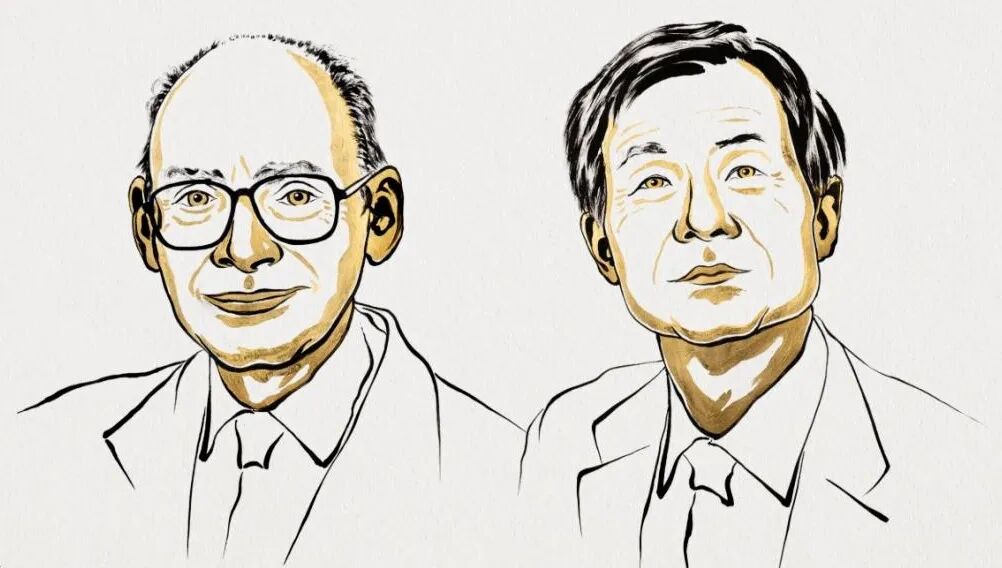
The 2026 Nobel Prize in Chemistry winners were announced on October 7. Dr. Henri B. Kagan and Dr. Kenso Soai were jointly awarded the prize for their groundbreaking discoveries concerning nonlinear effects and autocatalysis in asymmetric organic synthesis.
The Award-Winning Discoveries: Two Experimental Cornerstones Unraveling the Century-Old Mystery of Homochirality
The Puzzle: Why Does Life Prefer One Molecular Mirror Image?
Molecules like amino acids and sugars exist in two mirror-image forms that cannot be superimposed on each other. Chemists call this property chirality, and these mirror molecules are known as enantiomers. In 1848, Louis Pasteur famously used tweezers under a microscope to separate left- and right-handed tartaric acid crystals. He observed that they rotated polarized light in opposite directions, left and right. This was the first scientific confirmation that molecules could possess "left and right-handedness."
Even more puzzling, the amino acids that make up biological proteins are almost exclusively left-handed, while the sugars found in DNA are entirely right-handed—life is homochiral. In stark contrast, when chemists synthesize chiral molecules in laboratories, they invariably produce an equal mixture of both mirror forms. The origin of this asymmetry has been a persistent mystery in chemistry for over a century.
In 1953, theoretical physicist Charles Frank at the University of Bristol developed the mathematical framework necessary to address this problem. He proposed that a chemical reaction capable of spontaneously generating homochirality must meet three conditions simultaneously:
1. The presence of a chiral catalyst and an asymmetric reaction.
2. The amplification of one mirror form's production while suppressing the other.
3. Reaction products that catalyze their own formation (autocatalysis), leading to self-reinforcing exponential growth.
Subsequent Nobel Prizes in Chemistry, awarded in 2001 and 2021, recognized the fulfillment of the first criterion (asymmetric catalysis). The 2026 Prize honors the experimental achievement of the remaining two conditions in Frank's model.
Kagan: Nonlinear Effects — Chirality Can Be "Amplified"
In the early 1980s, research on asymmetric catalysis operated under a widely held, seemingly obvious belief: a catalyst's chirality transfers in a straightforward, linear fashion to the product. This meant that the ratio of the two mirror-image forms in the catalyst directly dictated the ratio of the resulting products. Henri Kagan of Paris-Sud University questioned this assumption. He observed that metal ions, which act as the reaction's "engine," can typically bind multiple chiral ligands simultaneously. When both left- and right-handed ligands are used as starting materials, three types of catalysts can form within the system: "right-right," "left-left," and "left-right." The key insight here is that the "left-right" complex, which mixes different handedness, has significantly lower catalytic activity than the other two. Consequently, it effectively removes some of the less effective ligands by incorporating them into low-efficiency complexes.
Consider a mixture where 75% of the ligand is right-handed and 25% is left-handed. After random pairing, the proportion of catalysts that efficiently drive the reaction shifts to approximately 90% right-handed and 10% left-handed. This significantly amplifies the enantiomeric excess (ee) of the product, meaning the product becomes purer than the original catalyst mixture. In 1986, Kagan published findings in the Journal of the American Chemical Society (J. Am. Chem. Soc. 1986, 108, 2353–2357) detailing three asymmetric reactions that demonstrated these nonlinear effects. The graphical representations showed curved lines instead of the straight lines the scientific community had previously assumed, thus fulfilling the second condition of Frank's model. Crucially, nonlinear effects (NLE) quickly became a valuable diagnostic tool for chemists. By measuring the curve that relates the product's ee to the ligand's ee, researchers can now determine the specific reaction mechanism and optimize reactions with greater precision.
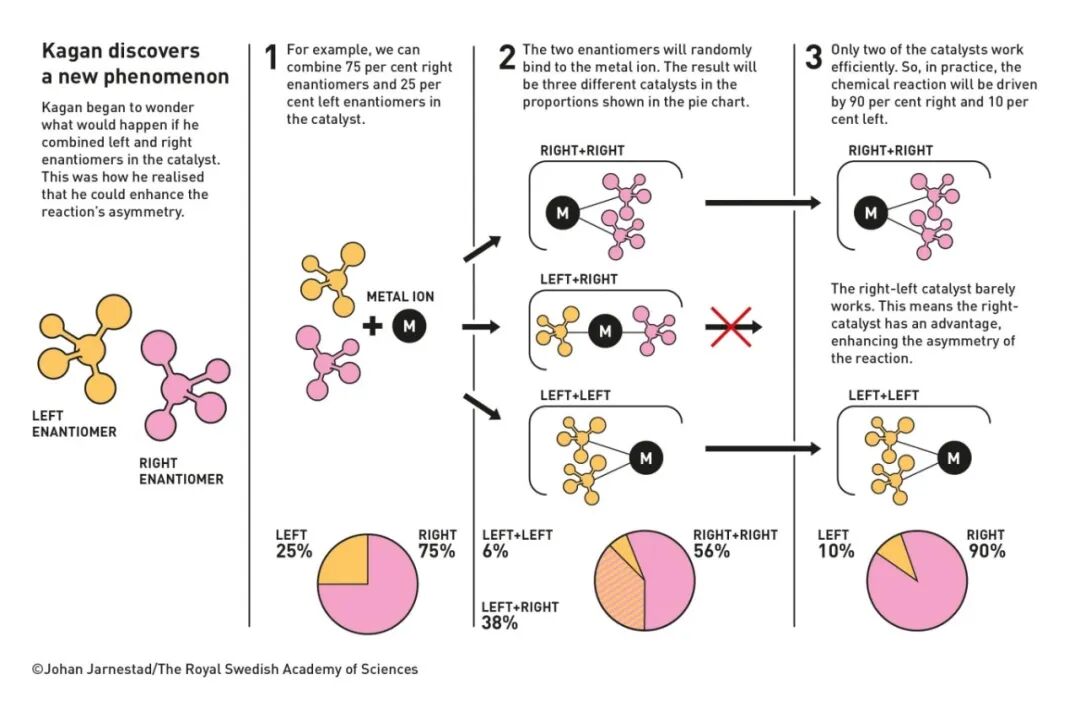
Figure 1. Kagan’s Discovery: Random association of left and right-handed ligands with metal ions produces three catalyst species (56% right–right, 38% left–right, 6% left–left). The left–right complex is nearly catalytically inactive. As a result, efficient catalysis is dominated by 90% right-handed and 10% left-handed species, which amplifies the asymmetry of the reaction.
Soai: Asymmetric Autocatalysis — Chirality Grown from an Achiral Starting Point
Kenso Soai of Tokyo University of Science provided the final piece of this scientific puzzle. While investigating an asymmetric reaction that displayed strong nonlinear effects, he noticed a significant structural similarity between the catalyst and the reaction's product. This observation inspired him to search for a chiral molecule capable of catalyzing its own creation. Following extensive molecular screening, he identified 5-pyrimidyl alkanol. His groundbreaking 1995 paper reported that starting with a slight excess of just 2% ee, the product's ee was amplified to 87% through autocatalytic cycles. For the first time, all three criteria of Frank’s model were met within a single reaction.
In 2003, Soai presented results that the Nobel Committee later described as “one of the most elegant chemical experiments ever performed.” Beginning with a completely achiral solution, tiny random fluctuations initially produced a minuscule excess of approximately 0.00005%. This favored enantiomer then dominated the entire reaction. After three sequential additions of substrate and reagents, the product’s ee surpassed 99.5%, reaching a maximum attainable value of 99.99%. In repeated experiments, whether the left-handed or right-handed enantiomer ultimately prevailed was determined by random chance at the outset. This marked the first laboratory demonstration of chiral symmetry breaking in humans, transforming a fully achiral system into products with high enantiomeric excess, mirroring the origin of life. It also offered the first experimentally verifiable chemical pathway explaining how biological homochirality could have emerged.
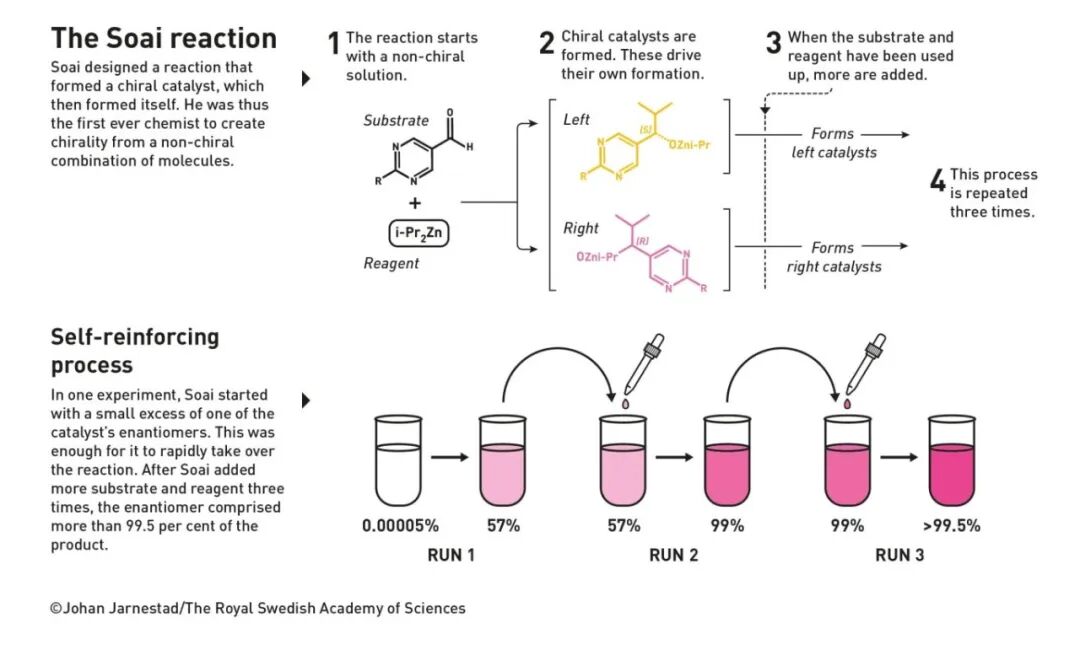
Figure 2. The Soai Reaction: In an achiral starting solution, a tiny amount of chiral catalyst is randomly generated. This catalyst then promotes its own replication, a process of self-amplification. After each addition of substrate and reagents, the favored enantiomer's presence is further amplified, progressing from 0.00005% to 57%, then to 99%, and finally exceeding 99.5%.
Organic synthesis forms the bedrock of modern pharmaceuticals and fine chemicals.
These two discoveries, nonlinear effects and autocatalysis, were awarded the Nobel Prize decades after their initial conception because they have evolved from fundamental scientific puzzles into routine industrial tools. The Nobel Committee emphasized that Kagan’s nonlinear effects are now a standard method for chemists to understand reaction mechanisms and optimize enantiomeric purity when developing new synthetic processes. These techniques are "vital to every company that manufactures substances interacting with living organisms," encompassing pharmaceuticals, fragrances, flavors, and agrochemicals, and are also critical for producing certain advanced materials.
Chirality holds significant commercial value because living organisms are inherently chiral environments. When two mirror-image molecules are introduced into the human body, they can elicit entirely different responses. Several well-established facts firmly support this principle:
Mirror Images, Different Risks: One Enantiomer Treats Disease, While the Other May Cause Harm
The early 1960s thalidomide crisis starkly illustrated the risks associated with chiral molecules. This sedative rapidly converted into its mirror image within the body, and it was this unintended enantiomer, not the intended active substance, that caused severe birth defects. Similarly, for the antituberculosis drug ethambutol, the (S,S)-configuration is therapeutically effective, while the (R,R)-form is about 500 times less potent against pathogens and can cause optic nerve toxicity. The antidepressant escitalopram, which is the S-enantiomer, achieves the same therapeutic effect as 40 mg of racemic citalopram (a mixture of both enantiomers) at a significantly lower dose of just 10 mg.
These incidents led to stricter regulatory requirements. The FDA typically mandates an enantiomeric excess (ee) value above 98% for chiral active pharmaceutical ingredients (APIs), and ICH Q6A guidelines require precise control over the enantiomeric impurity profile.
Industry practices reflect these stringent requirements. Statistics on new small-molecule drugs approved by the US FDA between 2013 and 2022 reveal that approximately 60% are single-enantiomer molecules, a significant increase from earlier periods. Racemic mixtures have declined, accounting for only around 3.6% of approvals in this period, down from 11% between 2003 and 2012. Industry analyses also indicate that modern drug molecules frequently contain two to four chiral centers. The global market for chiral chemicals was valued at approximately USD 77.4 billion in 2024 and is projected to reach USD 125.8 billion by 2030. The pharmaceutical sector accounts for about seventy percent of this volume; the remainder includes achiral products or compounds with undisclosed stereochemistry.
Looking at the bigger picture, from designing synthetic routes and creating single-enantiomer bioactive molecules to controlling molecular conformations in advanced functional materials, modern pharmaceuticals and fine chemicals rely heavily on organic synthesis. The practical significance of this foundation is clear: every potential molecule, every synthetic pathway, and every measure of chiral purity must be validated through physical samples and experimental data before informing research and development decisions.
Where AI Design Connects: Physical Validation Through Wetlab Experiments
This year's Nobel Prize serves as a crucial reminder for AI in scientific discovery (AI4S). AI-powered retrosynthesis and generative models can propose synthetic routes and evaluate potential drug candidates within hours. Academic estimates suggest the chemical space of drug-like molecules is vast, on the order of 10⁶⁰. Algorithms have indeed made exploring this space more affordable than ever. However, any molecule or synthetic route generated by these models remains purely hypothetical in the real world. Whether a molecule can be synthesized with a good yield and ee, whether consistency can be maintained from batch to batch, and whether impurity profiles can be controlled are questions that can only be answered through experimentation.
A different perspective clarifies this point: generative models alone, without experimental execution, produce candidate molecules that are merely sequences of characters. Automation alone, without standardized data, prevents experimental results from being used to train models. Data alone, without traceable process records, leaves the active-learning feedback loop without the necessary input.
The Soai reaction vividly exemplifies the critical need for precision in experimental execution. In this reaction, the final handedness of the product is determined by an initial random fluctuation as small as 0.00005%. This means the reaction is highly sensitive to starting conditions, dosing accuracy, and process control, reaching down to physical limits. At this scale, experimental reproducibility and data traceability are essential for drawing reliable conclusions. In the AI era, the main challenge in chemical R&D is no longer the number of ideas generated by the design process, but rather the capacity of the validation side to reliably handle these candidates. High-throughput, reproducible wet-lab capabilities, coupled with complete process records, dictate the speed at which hypotheses can be confirmed or refuted.
Ou Shisheng is developing precisely this infrastructure for physical validation and data management, enabling efficient, unmanned operation for various autonomous downstream laboratories. Each validation concludes with structured, traceable data. Consequently, hypotheses proposed by AI receive stable, comparable physical responses, and validation results feed back into models as high-quality datasets. Designs are accelerated by algorithms, and conclusions are validated in autonomous laboratories—this completes the "dry-wet closed loop."
Validation Capacity Becomes a Scarce R&D Asset
From the data plots observed in 1986 to the Nobel Prize awarded in Stockholm in 2026, it took decades for Kagan and Soai's discoveries to evolve from experimental findings into practical industrial tools. The reliability of chemical conclusions has always depended on their reproducibility and verification. As AI significantly lowers the cost of molecular design, the genuinely scarce resource in R&D competition becomes high-throughput, reproducible, and storable physical validation capacity, along with the data collected during these processes.
The enduring mission of Ou Shisheng, as a provider of "intelligent experimental infrastructure for materials science R&D," is to execute every experiment with precision, record it completely, and reuse the data for AI models. This is achieved by empowering scientists’ dreams through an intelligent instrument ecosystem.